Zhukov: the people behind the Eastern Front map
An imagined conversation about invasion, military decisions and the human cost obscured by arrows on a map.
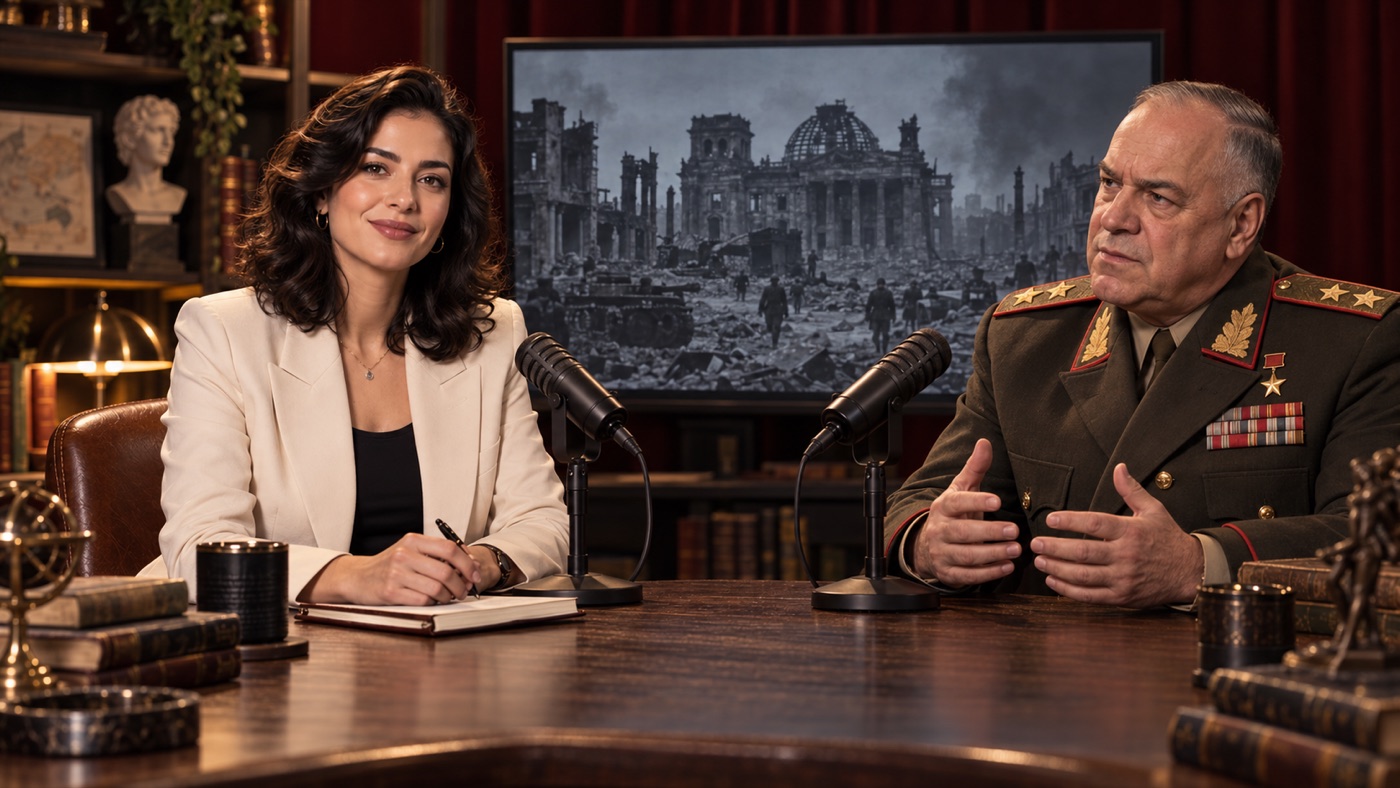
These are fictional dramatisations, not real interviews or authentic quotations. Host Defne Arman is a fictional character, unrelated to real individuals. First-person answers are imagined from the cited historical material. Images are AI-generated. No audio or video recording is available.
Defne Arman asks; Georgy Zhukov answers in an imagined dialogue.
What changed on 22 June 1941?
Georgy Zhukov · fictional answerThe Nazi invasion changed the scale and nature of the war. Alongside the clash of armies came systematic violence against civilians. Behind the lines on a map were people driven from their homes and murdered.
What lies beyond the arrows on a military map?
Georgy Zhukov · fictional answerSupplies, weather, distance and the endurance of soldiers. Casualty tables conceal families and cities. A report from the front cannot tell the whole story of a war.
Was the road to 1945 a continuous sequence of victories?
Georgy Zhukov · fictional answerIt included retreats, encirclements and enormous losses. The Soviet advance into Berlin was decisive in the defeat of Nazi Germany. An account of victory must also keep occupied civilians and war crimes in view.
What would you ask people who tell this history today?
Georgy Zhukov · fictional answerWhose names were recorded, and whose voices became numbers? Look at the methods used and the people who survived, as well as the outcome.
Sources & further reading
Source links retained from the original editorial dossier. Dialogue and commentary are not quotations from these sources.